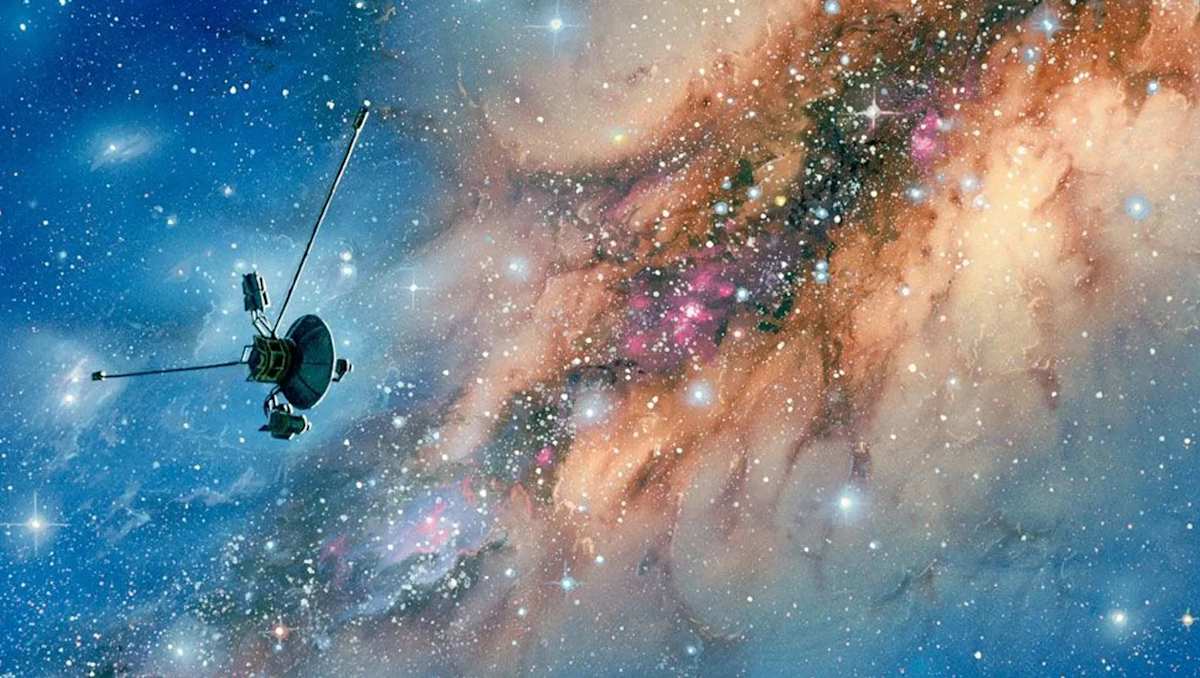
Voyager 1 will soon achieve a cosmic milestone. Allow me to explain…
When you turn on the light in a room it looks like it becomes instantly bright. But that's not quite the case. In reality, light races from the bulb at nigh on 186,000 miles per second, so it doesn't fill the room instantaneously - but it does get mighty close
186,000 miles per second is mind bogglingly fast. At that speed you could circle the Earth seven times in the blink of an eye, or reach the moon in just over a second.
But what it we stretch that out? How far could light travel in a day? The answer is that in one full day, light covers 16 billion miles. It's a vast distance - even compared to our solar system. For example, the planet Neptune is the furthest out from the sun of the eight major planets that circle it. 16 billion miles is enough to traverse the diameter of Neptune's orbit not once, not twice, but three times, with distance to spare. In fact, 16 billion miles is roughly the distance Neptune covers during one lap around the sun. Neptune takes 165 years to cover this distance; light can do it in a day.
To put this into context, if we were to try and drive 16 billion miles at motorway speed it would take us 23 million years!
So it might seem inconceivable that a manmade object could cover such a distance. But the astonishing news is that one of our spacecraft, Voyager 1, is about to reach that very milestone in late 2026. In other words, Voyager 1 will soon be one light-day away from Earth. That means if you send it a signal, the reply won’t come back until tomorrow.
Voyager 1 began its journey back in 1977, launched from Cape Canaveral. It was part of a pair, Voyager 1 and Voyager 2, designed to explore the outer planets. Voyager 1 flew past Jupiter in 1979, then Saturn in 1980, sending back images that stunned the world before hurtling out into deep space. Voyager 2 took the grand tour, also visiting Jupiter and Saturn before going on to visit Uranus and Neptune - the only spacecraft to see them up close.
When the Voyager probes were launched they didn't just fly straight out to their targets with the sun at their backs. To reach the outer planets and the speeds required to cover such vast distances they used something called a gravity assist or slingshot manoeuvre.
So how does this work? Imagine you could take a God's eye view of the solar system and look down on all the planets orbiting the sun like runners going around a circular track. When the probes launched from Earth they spiralled out towards Jupiter, like a runner changing lanes. Both of them had to catch Jupiter up, meaning that Jupiter was racing away while they were racing to catch up. All this time, Jupiter's gravity was pulling at them and this long, drawn out fall, gave them a significant increase in speed. On leaving Jupiter, they changed course and spiralled out again, repeating the trick with Saturn.
For this to work; the planets need to be in very specific positions - and this was the case in the late 1970's. It's a situation that won't happen again until the mid-2150's so NASA had to race against an immovable deadline to get the probes finished. In Voyager 1's case it reached Jupiter and Saturn before being flung out on a direct route out of the solar system. Voyager 2 was the special one, its launch timed to repeat the same slingshot trick with Jupiter, Saturn, then Uranus and Neptune, before finally heading out of the solar system itself.
Today, both Voyagers are beyond the bubble of the Sun’s influence — in interstellar space. Their instruments are still working, though power is fading. They’re now measuring cosmic rays, magnetic fields, and the thin plasma between the stars. No other spacecraft has ever sent back data from this region.
And each carries a message: the Golden Record. A disk etched with images, greetings in dozens of languages, sounds of Earth — waves, birdsong, laughter — and music from Bach to Chuck Berry.
So spare a thought for Voyager 1, as it travels through the deep black. It's a time capsule, a postcard from humanity, drifting forever through the stars...