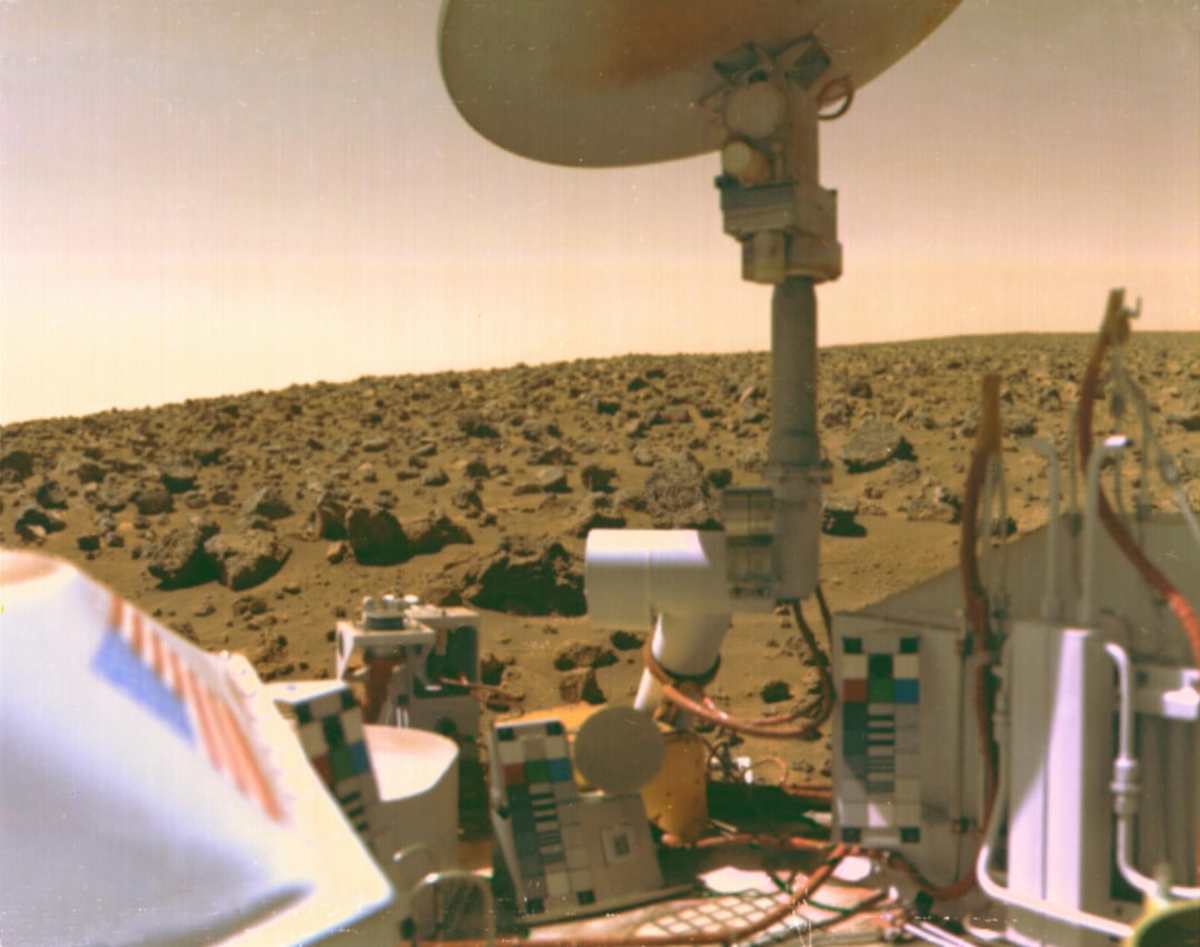
Fifty years ago, in July and September of 1976, two American spacecraft settled onto the surface of Mars and transformed our understanding of the Red Planet. Back then was the aftermath of the Apollo program that took men to the moon. NASA budgets were shrinking, if still large when compared with those of today. There was a drive for missions with ambition that could both capture the public imagination and maintain Cold War prestige. The first robotic probe to land on Mars sought to answer the question of whether that planet supported life. It ticked all the boxes.
Viking 1 touched down on July 20, 1976, on the western slopes of Chryse Planitia, exactly seven years after Apollo 11 landed on the Moon. Viking 2 followed on September 3, coming to rest on the flat, rocky expanse of Utopia Planitia. Together, these twin landers opened a new era in planetary exploration.
The Viking missions were ambitious in scale and design. Each spacecraft consisted of two major components: an orbiter and a lander. The orbiters were based on earlier Mariner spacecraft but carried more powerful propellant tanks and a more capable suite of instruments. Their job was to ferry the landers safely to Mars, perform high‑resolution imaging to identify safe landing sites, act as communications relays, and conduct scientific observations from orbit. The landers, meanwhile, were robust, three‑legged vehicles equipped with cameras, weather sensors, a robotic arm, and a full biological laboratory. They were powered by radioisotope thermoelectric generators—RTGs—which used the heat from decaying plutonium‑238 to generate electricity, allowing them to operate long after their nominal 90‑day lifetimes.
The Titan IIIE‑Centaur, heavy lift rocket was used for both Viking 1 and 2. The large spacecraft required a powerful vehicle to get them to Mars. After arrival, the orbiters spent weeks mapping the surface. Only once mission planners were confident in the safety of the terrain did they release the landers for descent.
The landing sequence itself was a carefully choreographed. Each lander entered the Martian atmosphere protected by an ablative heat shield - one that sheds heat by slowly sacrificing itself. Parachutes deployed to slow the descent, and in the final moments, retro‑rockets fired to bring the lander gently to rest on the surface. Viking 1’s landing was delayed from its original July 4 target—chosen to coincide with the U.S. Bicentennial—after images from orbit revealed hazards at the planned site. The new timeline happened to fall on July 20th, the date Neil Armstrong and Buzz Aldrin landed on the moon. The Apollo anniversary wasn’t planned, but once the date lined up, NASA certainly didn’t mind the symbolism.
Why did Viking land where it did? The answer lies in safety, science, and engineering constraints. The orbiters returned tens of thousands of images—52,663 in total—mapping 97 percent of the Martian surface at high resolution. These images revealed a planet divided into two broad regions: smooth northern plains and rugged southern highlands. The northern plains offered safer terrain for landing, with fewer boulders and gentler slopes. Viking 1’s site at Chryse Planitia was chosen for its relative flatness and scientific interest, while Viking 2’s site at Utopia Planitia provided a contrasting environment for comparison.
Once on the surface, the landers began an unprecedented scientific campaign. Their cameras returned panoramic views of a desert‑like landscape strewn with angular rocks and fine dust. Temperatures ranged from about –120 °C to –20 °C. The soil proved to be iron‑rich and chemically reactive. The landers carried instruments to analyse atmospheric pressure, temperature, wind, and soil chemistry. They also deployed seismometers, though these returned limited results due to mechanical issues.
But the heart of the Viking mission—the part that still sparks debate today—was the search for life. Each lander carried a biological laboratory designed to detect signs of microbial metabolism. The experiments were ingenious: they added nutrients to Martian soil samples and looked for gases that might indicate biological activity. The results were surprising. The soil reacted vigorously, producing signals that resembled metabolic processes. Yet other instruments, including the gas chromatograph‑mass spectrometer, failed to detect organic molecules. NASA concluded that the results showed “unexpected and enigmatic chemical activity” but no clear evidence of living microorganisms.
But the debate over the meaning of the results has never been fully settled. Some scientists argue that Viking may indeed have detected life, and that the absence of organics could be explained by highly oxidizing compounds in the soil—compounds that later missions confirmed. Others maintain that the results are best explained by non‑biological chemistry. The ambiguity remains one of the most tantalizing mysteries in planetary science.
The Viking orbiters continued their work for years, capturing stunning views of volcanoes, dust storms, and canyons. Viking 1’s orbiter operated until August 1980, while Viking 2’s orbiter ended its mission in 1978. The landers themselves far exceeded expectations: Viking 2 operated until April 1980, and Viking 1 continued transmitting until November 1982, when a faulty command ended its mission.
The cost of this undertaking was enormous. At the time of launch, the Viking program cost roughly $1 billion—some estimates puts that at over $7 billion in today's money. Viking remains NASA’s most expensive robotic planetary mission ever attempted. More than half of the cost went into developing the landers, with the orbiters and mission operations accounting for the rest.
Fifty years on, Viking’s legacy is profound. It provided the first complete picture of Mars, established the techniques for landing safely on another planet, and set the stage for every robotic mission that followed—from Pathfinder to Perseverance, and the Ingenuity helicopter. Viking also reshaped astrobiology. Its ambiguous results forced scientists to rethink how life should be detected, leading to new strategies and instruments that continue to evolve today.
So what comes next for Mars exploration?
The next decade will see a shift from reconnaissance to sample return and preparation for human missions. NASA and ESA are working toward returning samples collected by the Perseverance rover—an effort that will bring pieces of Mars to Earth for the first time. These samples may finally answer the question Viking raised: has Mars ever hosted life? Meanwhile, orbiters continue to map the planet’s climate and geology, and future landers may explore new regions such as the polar caps or ancient lakebeds. Human missions remain on the horizon as an achievable goal if we can first establish a viable settlement on the moon.
As we mark the golden anniversary of Viking, we’re reminded that exploration is a relay race. Viking ran the first lap—proving we could land, survive and search for life on another world. The missions that followed have carried the baton further, and the ones to come may finally deliver the answers Viking hinted at half a century ago.