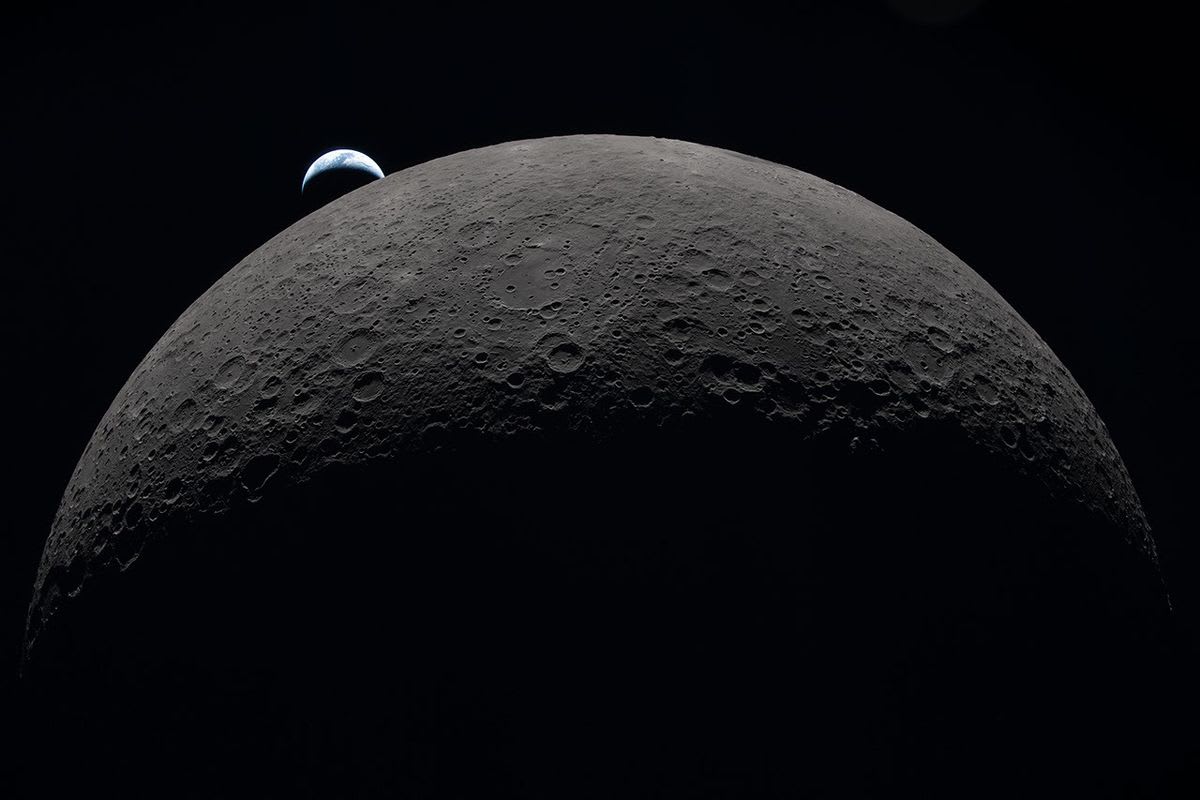
As of now, the Artemis II mission has just drawn towards a successful conclusion. This was the first mission to travel beyond the moon for over 50 years and has achieved a record for the furthest distance humans have ever travelled beyond the Earth. Without doubt, the most exciting part of this mission was when its four astronauts made observations of the 'dark side' of the moon.
We call it the 'dark side of the Moon' but that’s really just a triumph of drama over accuracy. It’s a phrase that sounds mysterious and therefore refuses to die. The far side isn’t dark at all. It has day and night just as the near side. The only thing that makes it “dark” is that we never see it from Earth. It’s not a realm of eternal shadow; it’s simply the half that doesn’t face us. Thus the moon's 'far side' is a more accurate description.
The reason the moon has a side we never see is due to something called 'tidal locking'. When the Moon first formed, it spun much faster than it does now. But Earth’s gravity tugged on the Moon’s slightly uneven shape, creating a kind of cosmic braking system. Over millions of years, that braking slowed the Moon’s rotation until it matched the time it takes to orbit the Earth i.e. one spin per lap and the same face became permanently turned toward us. In some ways, it's like a dancer who keeps their gaze fixed on you no matter how they move around the floor.
What has been widely reported is that the Artemis II astronauts have seen parts of the moon never viewed by anything but robotic spacecraft. This is true. The Apollo astronauts, back in the late 60's and early 70's, did see the far side, but only in slices, because Apollo orbited close to the Moon. In fact, the orbits were astonishingly close, sometimes just tens of kilometres above the surface. At that altitude, the Moon fills your entire window. You see craters, mountains, shadows, but not the whole hemisphere. It’s like trying to appreciate a cathedral while standing with your nose pressed against a pillar. You get detail, not perspective.
Artemis II changed that. Instead of orbiting, the spacecraft followed a big looping free‑return trajectory, swinging thousands of miles out behind the Moon before gravity swung the crew back toward Earth. That extra distance gave the astronauts something no human had ever had before: a sweeping, panoramic view of the entire far side all at once. Not just the close‑up scars of ancient impacts, but the whole hidden face hanging in space, complete and uninterrupted.
What can be seen from their images is how utterly different the far side looks from the near side. No broad dark patches. No familiar “Man in the Moon.” Instead, it’s a riot of craters—craters on craters, craters inside other craters, as if the far side has been used as target practice for the last four billion years.
The reason for this difference lies in the varying thickness of the Moon’s crust. The near side, the one we see, has a thinner crust. That made it easier for ancient volcanic eruptions to break through and flood huge impact basins with dark basaltic lava. These cooled into the smooth, dark plains early astronomers mistook for seas. They called them maria, and the name stuck. They’re not seas at all, of course, just vast frozen lava lakes; but they give the near side its distinctive face.
The far side, however, has a crust up to twice as thick. When big impacts happened there, the crust didn’t crack open as easily. No lava welled up to fill the basins. So the far side kept its battered, cratered appearance, while the near side was resurfaced and smoothed in places. The reason why the crust is thicker on the far side is because, early in the Moon’s history, heat from the still‑molten Earth kept the near side warmer for longer. That extra warmth slowed the solidification of the near side crust, leaving it thinner while the far side cooled faster to harden into a much thicker shell.
One of the most extraordinary features on the far side is the South Pole–Aitken Basin; one of the largest impact craters in the entire solar system. It’s so vast that if you stood inside it, you wouldn’t realise you were in a crater at all. It’s also incredibly ancient, dating back more than four billion years. That region is rich in scientific promise. The Artemis programme’s interest in the lunar south pole isn’t just about exploration—it’s about understanding the Moon’s early history, and perhaps even finding water ice tucked away in permanently shadowed craters. With sunlight never reaching them temperatures plunge so low that any water delivered by comets or asteroids could remain frozen for billions of years.
The far side also tells a story about the early solar system. The sheer number of craters is a record of the heavy bombardment that shaped not just the Moon, but Earth as well. Our planet was hit just as often but erosion, weather, oceans, and plate tectonics have erased most of the scars. The far side is like a geological archive, a library of impacts stretching back to the dawn of the solar system.
For me though, incredible as the far side of the moon is, what I hope Artemis II will remind us is just how beautiful our home is. Whatever the wonders the moon has to offer, they aren't a patch on those of our own planet. Missions like this show us just how beautiful and precious our home really is.