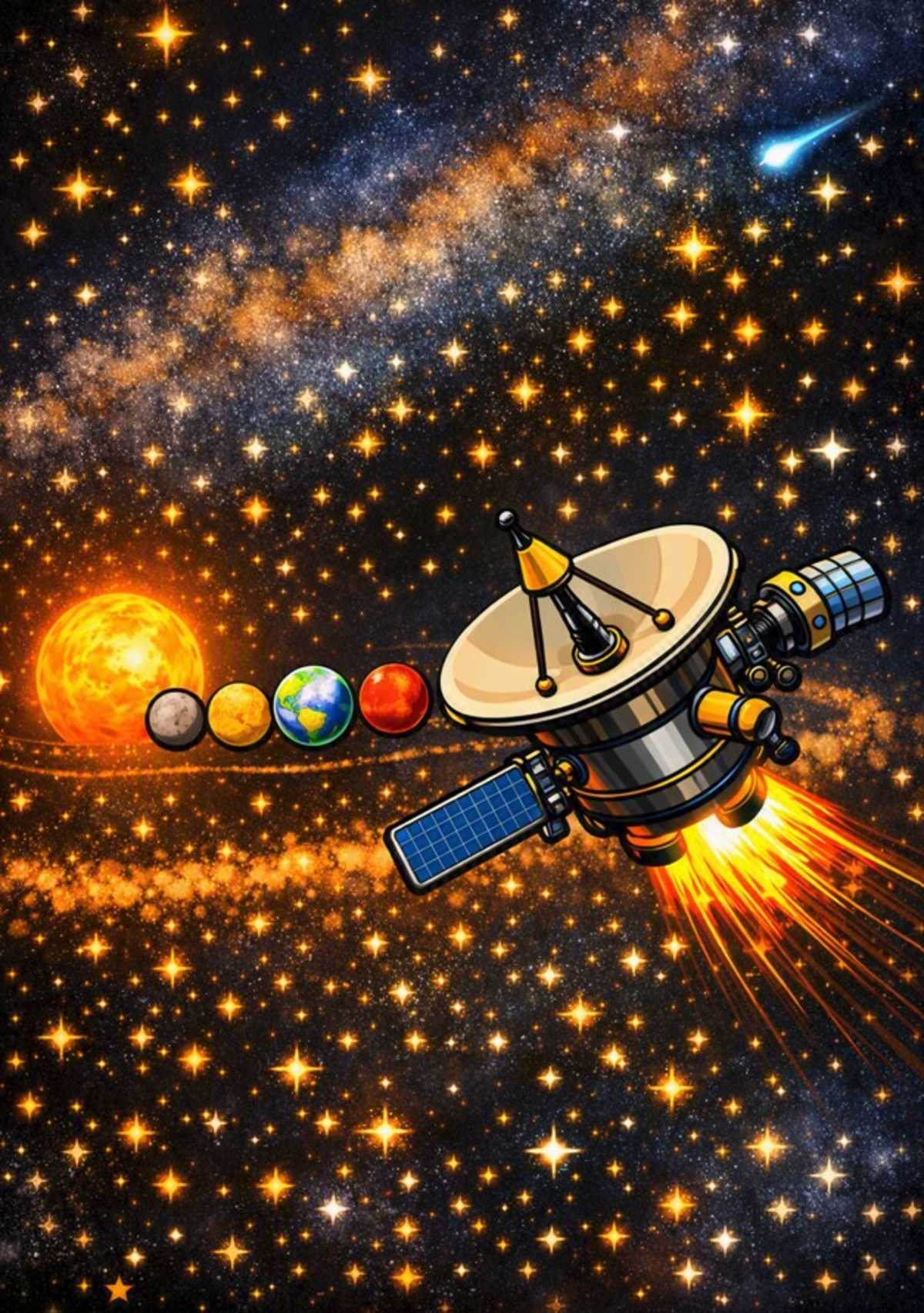
Today I'd like to discuss the difficulty of going up. But, not in the sense of getting into orbit, which is already hard enough to cause engineers many a sleepless night. What I actually mean is something harder still, much harder. I mean the difficulty of going up in in the sense of flying missions that don’t simply stay within the neat, flat, well‑behaved orbital plane of the planets in our solar system. Because once you try to break out of that, you discover the universe has absolutely no interest in making it easy.
Why? Well, it’s all do with how fast celestial objects move.
Let’s begin with the Earth. It spins - quite fast. If you’re standing on the equator, you’re quietly hurtling eastward at almost a thousand miles an hour relative to the centre of the Earth, a speed which I think equates to roughly 3 football pitches a second. In fact, if you can find a straight piece of road on the equator and travel due East at 100 miles per hour or so, you will be doing a thousand miles per hour. Not that I advocate this, it’ll be a hard sell to local law enforcement that you’re in the middle of a scientific experiment.
But, joking aside, this is why rockets launch eastward whenever possible. They’re taking advantage of that free, thousand‑mile‑an‑hour push. It’s the cosmic equivalent of making use of a moving walkway at an airport. You may still have to hurry to catch your flight, but at least you’re getting some free help. Of course, for the orbital assist due to the Earth’s spin to work you have to be near the equator. Launch from Florida, and you get almost the full benefit. Launch from Scotland, and you get… well, a polite suggestion. Launch from the poles, and you get nothing at all. The Earth is still spinning beneath your feet but you will be twirling in place like a ballerina.
Now, why does all this matter? Because the planets — and most spacecraft — orbit in roughly the same plane. The solar system is basically a giant cosmic pancake. A very thin one. A crepe, really. This flatness comes from the way the solar system formed. Long ago, a cloud of gas and dust collapsed under gravity. As it fell inward, it spun faster — the same way a figure skater spins faster by pulling in their arms. And, as it did so, the collapsing cloud flattened into a disc – a bit like make a pizza base. Planets formed inside that disc, and they’ve been obediently following its plane ever since.
This is extremely convenient and it makes getting around the solar system relatively straightforward. Not easy, by any means, but it doesn’t take as much energy as you might think. To travel from Earth to Mars from Low Earth Orbit, for example, requires an extra 4km/s of delta v. Delta v just means a change in speed. 4km/s is a lot, but remember this figure, it’ll seem far less significant later on. For a start, compare this with getting into orbit, that needs almost 8km/s of delta v, plus an additional margin to account for atmospheric drag.
You can reach other planets than Mars with only a bit more delta v, relatively speaking, and from there you can take advantage of something called a gravity assist. If you fly past a planet in the right way, taking longer to fall towards it than leave it again, you can pick up speed. This can be done by flying in behind the planet’s orbital track and catching it up while it tries to move away. What’s more is you can also use this trick to change direction, all without burning fuel. What is going on is that your spacecraft is stealing some of the planet’s orbital momentum. The planet doesn’t notice — it’s enormous — but your spacecraft does. Want to get to Jupiter? Steal some momentum from Venus, then Earth, then maybe Earth again. Want to get to Saturn? Borrow a bit from Jupiter. Want to get to Neptune? Borrow from everyone; it’s a long trip.
But gravity assists only work easily within the orbital plane. The planets are all there, neatly arranged like stepping stones. If you want to go out of the plane — if you want to go “up” — there are no stepping stones. You’re trying to climb a ladder that isn’t there.
Here’s where things get truly difficult. The Earth doesn’t just spin quickly; it orbits the Sun VERY quickly. In fact, the figure is 30km/s - remember that figure of 4km/s for getting to Mars earlier? Also, remember that I told you we’re spinning at 3 football pitches a second? Our orbital speed, 30km/s, equates to roughly 300 football pitches a second! So, if you want to go into polar orbit around the Sun you have to cancel most of that sideways speed – and then pile it back on again in an entirely new direction. To get a circular, polar orbit that's a delta V change of about 60km/s. Once again, compare that with the 4km/s needed to get to Mars. This is the difficulty in going ‘up’. It’s so difficult, in fact, that almost no spacecraft have ever done it.
But “almost none” is not “none.” A few brave missions have indeed gone up — out of the plane, into the cosmic attic. The most famous is Ulysses, launched in 1990. Its job was to study the Sun’s poles, which are very hard to see from the orbital plane. But Ulysses didn’t have the fuel to tilt its orbit on its own. So it used Jupiter — the largest planet in the solar system — as a slingshot. Ulysses flew out to Jupiter, dove past it, and let Jupiter’s gravity fling it up and out of the plane. It worked beautifully. Ulysses spent years looping over the Sun’s poles, sending back data no one had ever seen before.
Another mission, Pioneer 11, also achieved a significant tilt using Jupiter, though not as dramatic as Ulysses. And Voyager 1 and Voyager 2, while not truly polar, ended up on trajectories that take them far above and below the plane as they leave the solar system entirely — the ultimate “up.”
But these missions all relied on Jupiter. Without Jupiter, they would have needed fuel tanks the size of office buildings.
In the future, there is an idea to use the Sun itself to fling a spacecraft out of the orbital plane. The sun has the strongest gravity in the solar system. The trick is to dive very close to the Sun, pick up enormous speed, and then use that momentum to tilt your orbit sharply upward. It’s orbital mechanics with a touch of daredevilry.
Going up is hard because the universe, for all its beauty, is not designed for our convenience. It’s designed for stability, for order, the precise, dependable motion of planets orbiting in a plane.
Of course, beyond the solar system it gets harder still. After breaking out of the orbital plane we have the staggering distances between the stars themselves to contend with. But, that’s a whole other story…