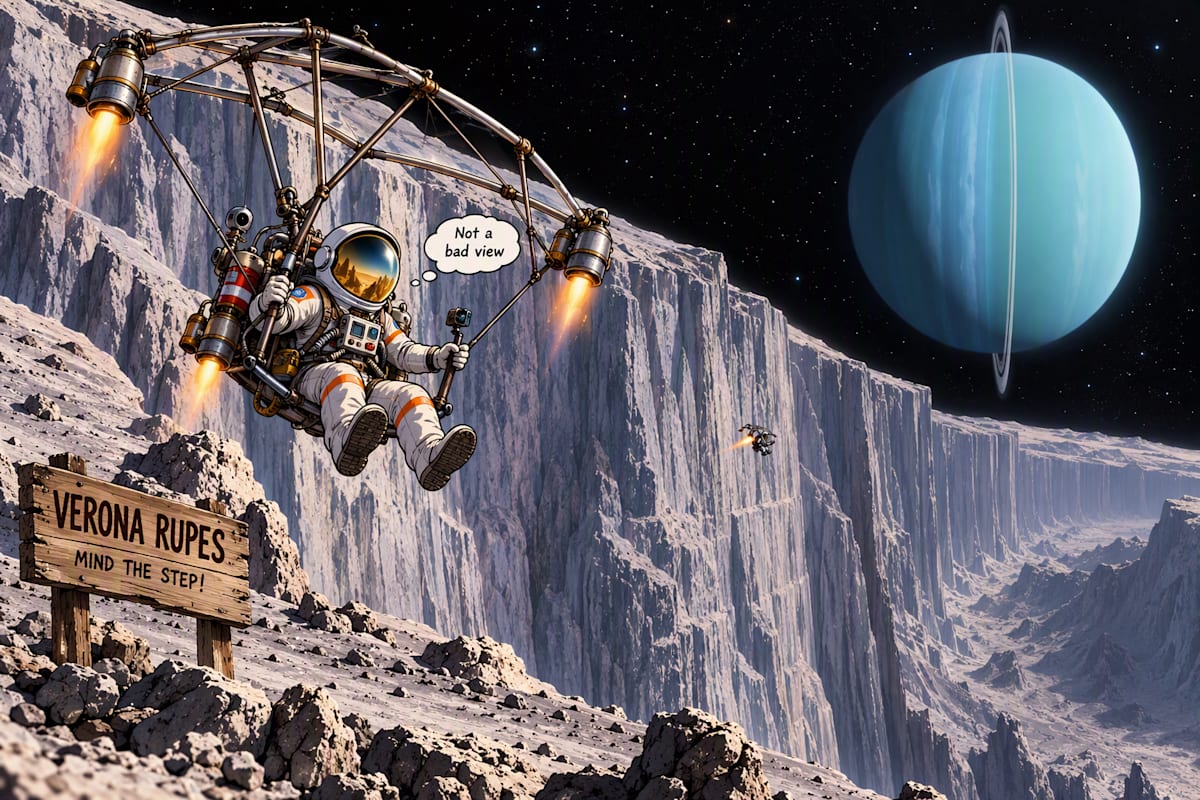
I am lucky enough to live in a place surrounded by hills with some scenic drops down to the valley below. When the weather's right I can watch people paragliding. And that got me thinking, what if I told you about the ultimate place to do this in the solar system.
Now, Mars is the standard answer for extreme geology. After all, Mars has vast canyons that could tuck the Grand Canyon away in a side spur. It is the home of Olympus Mons, a volcano double the height of Everest. But, no, the answer is somewhere stranger: a tiny moon orbiting Uranus.
The moon is called Miranda, and it is home to a colossal cliff known as Verona Rupes. There is some uncertainty over its exact height, but it may soar as much as 20 kilometres above the surrounding landscape. To put that into perspective, the White Cliffs of Dover rise about 100 metres above the English Channel. Ben Nevis stands 1.3 kilometres high. Even Mount Everest reaches only 8.8 kilometres above sea level. Verona Rupes could be easily double that.
And it gets stranger still. On Earth, falling from such a height would be a spectacularly bad idea. On Miranda gravity is so weak that a person stepping off the top might spend up to thirteen minutes drifting towards the bottom. Alas, the impact speed would be fatal, but there would be plenty of time to come up with a Plan B on the way down.
Miranda is actually one of the strangest worlds in the Solar System. When scientists first saw close-up photographs of it their first thoughts were that they were looking at a moon that had somehow been broken apart and put back together again - badly.
Miranda was discovered in 1948 by the Dutch-American astronomer Gerard Kuiper at the McDonald Observatory in Texas. He named it after a character in Shakespeare's The Tempest, continuing the tradition that gives Uranus's moons names from Shakespeare and Alexander Pope rather than from classical mythology. However, for decades after its discovery Miranda remained little more than a remote point of light. Astronomers knew where it was, roughly how large it was, but almost nothing about what it looked like.
That changed dramatically in January 1986 when NASA's Voyager 2 spacecraft swept through the Uranus system. Voyager had already rewritten the textbooks on Jupiter and Saturn, discovering active volcanoes, complex ring structures and previously unknown moons. But while Uranus was on the featureless side, Miranda made up for it in spades.
As the first detailed images arrived on Earth, scientists stared at a landscape that seemed to make no sense.
Parts of the surface looked ancient, heavily cratered and battered by billions of years of impacts. Other regions appeared completely different. They were covered in strange ridges, enormous grooves and vast patterns unlike anything seen elsewhere in the Solar System. Some areas seemed to stop abruptly at sharply defined boundaries, as though gigantic sections of crust from different worlds had simply been stitched together.
One NASA scientist compared Miranda to Frankenstein's monster, assembled from mismatched parts. It was a memorable description, and looking at the images even today, it is easy to see why.
The mystery is that Miranda is tiny. At just under 500 kilometres across, it is smaller than many countries. Planetary scientists generally expect small worlds to be geologically boring. Big planets and large moons retain heat and remain active. Small objects cool down quickly and become relatively simple. Miranda appears to have ignored the rulebook completely.
Among its most remarkable features are three gigantic formations known as coronae. These immense, oval-shaped regions are criss-crossed by ridges and valleys stretching for hundreds of kilometres. They resemble neither mountain ranges nor impact craters. In some places the valleys are several times deeper than the Grand Canyon.
Then there is Verona Rupes itself. Even in photographs it is difficult to grasp the scale. The cliff appears to mark a place where enormous sections of Miranda's icy crust shifted relative to one another in dramatic fashion.
So what happened to this little moon?
One possibility is that Miranda was heated from the inside by powerful gravitational forces. Long ago, it may have been caught in an orbital resonance with one of Uranus's other moons. As its orbit changed, Miranda would have been repeatedly squeezed and stretched. This process can generate heat inside a moon.
We see similar effects elsewhere. Jupiter's moon Io is the most volcanically active body in the Solar System because of tidal heating. Saturn's moon Enceladus uses the same process to power spectacular geysers that spray water into space.
Scientists think Miranda may once have experienced its own version of this activity. Heat generated deep inside could have softened the icy interior, allowing material to rise towards the surface and reshape the landscape.
Another theory is even more dramatic. According to this idea, Miranda suffered a colossal impact that shattered it into pieces. The fragments later reassembled under their own gravity, creating the patchwork world we see today. The theory remains controversial, but it does help explain why neighbouring regions can look so dramatically different from one another.
But, if all of this were not strange enough, Miranda orbits a planet that effectively rolls around the Sun on its side.
Uranus is tilted by about ninety-eight degrees. Instead of spinning upright like Earth, it rotates almost horizontally. The result is a world of extreme seasons. Parts of Miranda can experience years of continuous sunlight followed by years of darkness. It is one of the most unusual environments in the Solar System.
Remarkably, we have still seen only part of it. Voyager 2 photographed mainly the southern hemisphere during its brief flyby. Large areas of the northern hemisphere remain poorly mapped. There could be equally spectacular cliffs, canyons and bizarre geological formations hiding on the far side, waiting for a future mission to reveal them.
Adding yet another twist to the story, recent research suggests Miranda may once have possessed a hidden ocean beneath its icy surface. Models indicate that internal heating could have maintained liquid water far below the crust for extended periods. If that is true, Miranda joins a growing list of icy worlds that may once have concealed underground seas. Every new ocean discovered, or suspected, in the outer Solar System expands our understanding of where potentially habitable environments might exist. It turns out that some very unexpected places can remain surprisingly active.
Forty years after Voyager 2's visit, Miranda remains one of the Solar System's great enigmas. We know enough to recognise it as extraordinary, but not enough to explain it fully. Was it shattered and rebuilt? Did it really harbour an ocean? How did its bizarre surface form? And just how high is Verona Rupes?
For now, those questions remain unanswered. But perhaps that is part of the appeal. Out in the cold darkness beyond Saturn lies a small, battered moon with cliffs taller than Everest, valleys deeper than the Grand Canyon, and a history so strange that scientists are still arguing about it. For a world less than 500 kilometres across, Miranda still makes most of the Solar System seem almost ordinary.