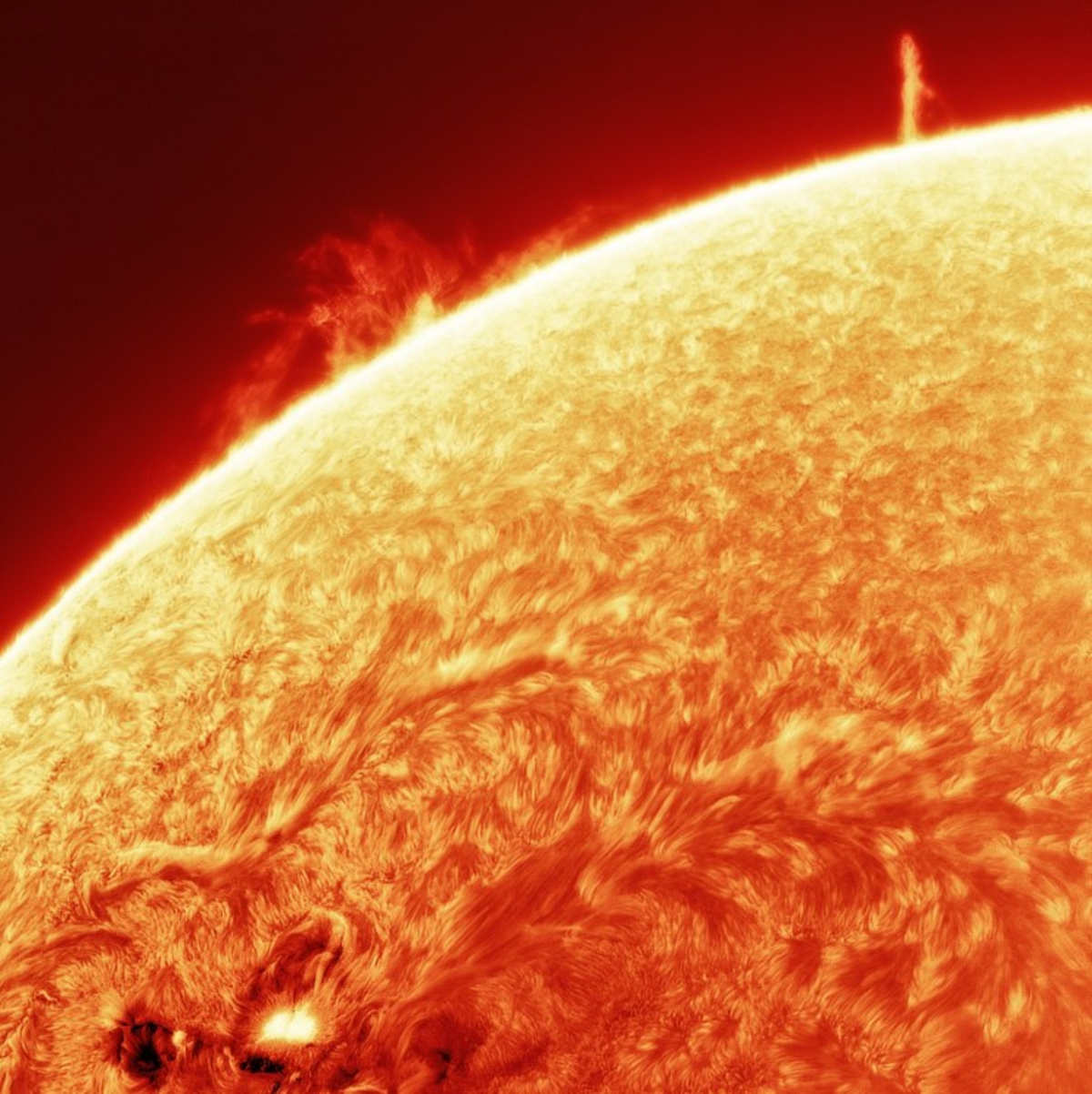
At the time of writing, here in the UK, and Europe, it's a month into summer and we're getting through a fierce and unprecedented heatwave. Temperature has been on everyone's mind.
So, let me start by asking, where's the hottest place in our solar system?
No, it's not your bedroom. However, the answer, surprisingly, is near Oxford. Yes, one of the hottest places in the known universe is tucked inside a building that looks, from the outside, like the sort of place that might store filing cabinets or run training courses on workplace safety. It houses the Joint European Torus — JET, as everyone calls it — and you’ll find a machine that has spent decades trying to bottle the power of the stars.
JET is a fusion reactor. The idea is to take the lightest atoms in the universe — hydrogen — heat them until they become a glowing soup of charged particles, and then squeeze that soup so tightly that the atoms fuse together. When they do, they release energy. Not just a little energy, but the same kind of energy that keeps the Sun shining. The trick, of course, is that to make this happen you need temperatures so high that the atoms forget all about being atoms. You need heat that makes the surface of the Sun look like a lukewarm bath.
And JET has done it. In its final experiments, it reached temperatures of around 150 million degrees Celsius. That’s ten times hotter than the centre of the Sun. Ten times. Inside that doughnut‑shaped chamber, held in place by magnetic fields so strong they could fling a car across a car park, we created a miniature star - a very polite, well‑behaved star, admittedly, one that lasts only a few seconds at a time, but still, a star.
So, why is JET so much hotter than the sun?
In this case, the answer is pressure. At the sun's core, it's hottest part, the weight of the layers above helps force hydrogen atoms together and reduces the temperature required for fusion to a mere 15 million degrees. It's a place where tonnes of particles collide, fuse and release the energy that lights our days, warms our skin, and drives all the weather on the planet - sometimes a bit too much.
What’s remarkable is how stable the Sun is. It’s been burning for 4.6 billion years and will keep going for another five billion or so. It’s the cosmic equivalent of a reliable old boiler — a bit noisy, occasionally temperamental, but fundamentally dependable. And yet, even with all that heat, even with all that power, the Sun is not the hottest place we know about. Not by a long shot.
Before we go there, let's take a stop off at the hottest planet that we're aware of. About 670 light years away is a planet with the rather unromantic name of KELT‑9b, orbiting a star in the constellation Cygnus. Calling it a planet is a stretch, KELT‑9b is more like a cosmic dare. It orbits so close to its star that a year — one full orbit — lasts just a day and a half. The star it orbits is nearly twice as hot as our Sun, and KELT‑9b is tidally locked, meaning one side always faces the star. That side reaches temperatures of around 4,300 degrees Celsius. That’s hotter than many stars. In fact, at 5500 Celsius, the surface of our own sun barely tops it.
At those temperatures, molecules can’t survive. They’re ripped apart into individual atoms. Even some metals turn to vapour. If you could stand on the surface — which you can’t, because the atmosphere is more like a drifting cloud of atomic debris — you’d be looking at a world so hot that the very idea of “solid” becomes a fond memory. It’s a place where the laws of chemistry decide that they have other things to do.
For the hottest thing out there we have to look at the universe’s true furnaces: the accretion disks around black holes. These are the swirling rings of gas and dust that spiral into a black hole and go to a place that we're still struggling to explain. In the process of falling the temperatures can reach hundreds of millions of degrees. In the most extreme cases — around supermassive black holes — the inner regions of the disk can hit billions of degrees. Billions. At that point, matter is so energised that it emits X‑rays and gamma rays, the sort of radiation that would sterilise a planet faster than you can say “factor fifty million”.
One of the hottest known spots is around the black hole in the centre of the galaxy M87 — the same one whose shadow was photographed by the Event Horizon Telescope, the first time we attempted to 'image' a black hole. The material swirling around it reaches temperatures of tens of billions of degrees. It’s hard to imagine what that means. Even the fundamental building blocks of matter likely lose cohesion.
It's remarkable that we can study these places. We can measure them, model them, and try to understand them. We can build machines in Oxford that mimic the processes at the heart of stars. We can look at distant planets and know their atmospheres are being peeled away by relentless heat. We can peer into the hearts of galaxies and watch matter being torn apart at temperatures that make fusion reactors look like a cosy winter fire. We’ve learned about places we could never visit, using nothing more than curiosity, mathematics, and a few well‑placed telescopes.
So, yes, it's been hot recently. Perhaps, on a cooler evening, look up at the sky and consider the hot places that are burning, boiling, and blazing far beyond our reach. And think about a quiet building near Oxford, a place that has made a significant step on the road towards nuclear fusion. If we ever crack that technology we will truly have a way of removing our dependency on fossil fuels, the cause of global warming, and the temperature extremes we're all having to endure…