In early April 2026, the Artemis II mission that flew around the far side of the moon concluded successfully. Four astronauts on board the Orion capsule reminded us what human beings can bring to deep space exploration through amazing pictures and insights. So, I thought I would round out the experience by taking a look at Artemis III, in terms of how its goals have shifted and the Apollo mission, from over fifty years ago, that it is most similar to.
Artemis III was originally meant to be the moment when astronauts once again stepped onto the lunar surface. In terms of technology, it really would have been a giant leap - and possibly a dangerous one. Astronauts would have been expected to fly to the moon with the Orion capsule then transfer to a lunar landing craft that had only ever been tested remotely. They would have flown down, explored the surface and returned using a craft, and spacesuits, that had never before been used by humans in space.
However, NASA recently made a strategic decision: Artemis III would no longer attempt a landing. Instead, it would become a crucial test mission in Earth orbit, designed to validate the systems that will eventually take astronauts back to the Moon. It’s a shift that reflects both the complexity of the programme and the lessons of history.
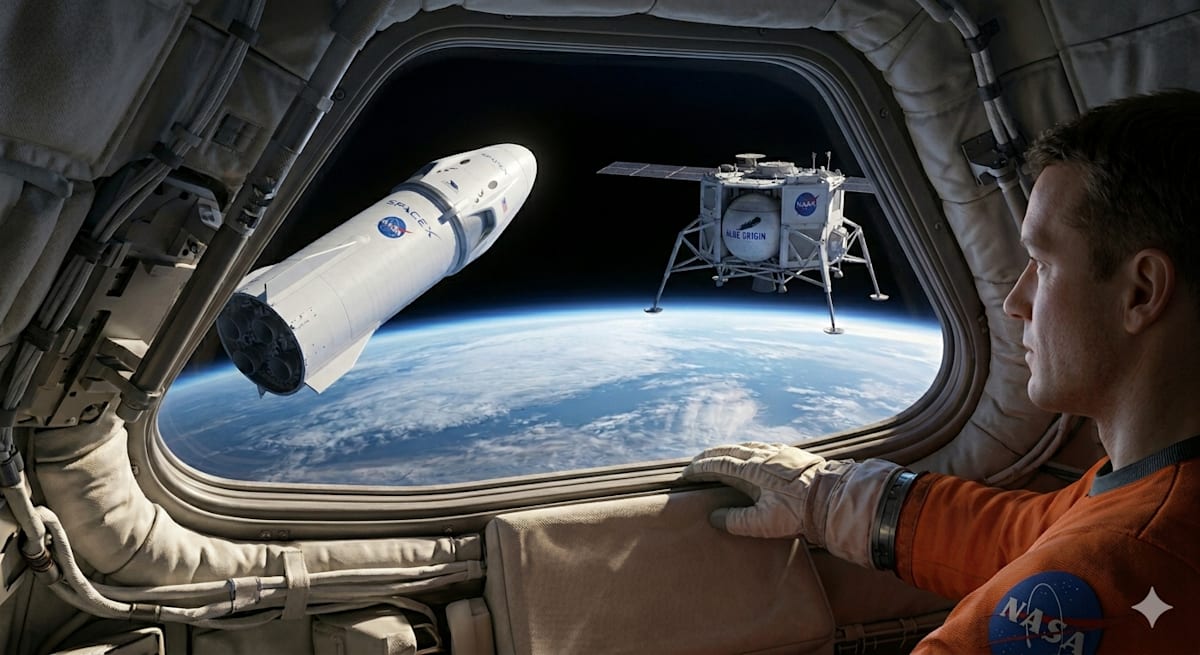
The reason for the change is straightforward. The privately developed, lunar landers that Artemis III depends on simply aren’t ready for a surface mission. NASA’s Orion spacecraft and the Space Launch System rocket have been progressing, but the Human Landing Systems, the vehicles that will actually carry astronauts down to the lunar surface, are still undergoing development. SpaceX’s Starship HLS, the larger and more experimental of the two, requires a series of successful orbital refuelling trials before it can even begin a lunar mission. Blue Origin’s Blue Moon lander, while more traditional in design, is still yet to fly. NASA found itself facing a familiar challenge: how to maintain momentum without compromising safety.
The solution was to re‑scope Artemis III. Instead of a landing, the mission will now focus on rendezvous and docking between Orion and the commercial lunar landers in Earth orbit. The aim is for the mission to fly in 2027, maintaining both momentum and the skills of NASA personnel. What does this mean? Well, one of the striking things about the build up to Artemis II was that it took months from first rollout to a successful launch. This was because waiting four years between flights of the Space Launch System is too low a frequency to maintain the learning required to set it up and fly it.
Artemis III will test docking with one or both of the candidate landers in Earth orbit. Once inside, astronauts will test life-support, communications systems, and the procedures that astronauts will rely on when they eventually make the journey to the lunar surface. The mission will also evaluate the new Axiom‑built lunar spacesuits, which are designed to offer greater mobility and improved life‑support performance when compared with the Apollo suits. In short, it will be a mission focussed on verification rather than exploration.
Let's take a closer look at the two lunar landers that Artemis III will, hopefully, be working with. They represent two very different approaches to the challenge of reaching the Moon.
The first is SpaceX’s Starship HLS. This is a variant of the company’s fully reusable Starship architecture, adapted specifically for lunar operations. It’s a large, stainless‑steel vehicle with a spacious interior and the ability to carry significant cargo to the lunar surface. Its scale is one of its defining features: it offers more room for astronauts than any previous spacecraft, and its long‑duration capabilities could support extended surface missions. But its size also introduces complexity. To fuel Starship for a lunar mission, SpaceX must launch multiple tanker vehicles and transfer cryogenic propellant in orbit—a manoeuvre that has never been attempted in spaceflight.
Blue Origin’s Blue Moon lander offers a contrasting philosophy. It’s smaller, more compact, and looks more like a direct descendant of the Apollo lunar lander. Developed with partners including Lockheed Martin, Draper, and Boeing, Blue Moon emphasises precision landing, modular cargo capability, and a simpler operational architecture. It won’t carry as much as Starship, and it won’t offer the same internal volume, but it may prove easier to certify and operate - although it is still envisaged to require an element of orbital refuelling. NASA selected Blue Origin as a second provider to ensure redundancy and competition—two qualities that have historically strengthened human spaceflight programmes.
It is a distinct possibility that one of these landers will not be ready for Artemis III. But the conducting it in Earth orbit should mean that propellant transfer operations do not need to be sorted out for this mission to go ahead. That should increase the odds that at least one of them will be ready.
Let's now take a look back at Apollo 9, the mission that provides the clearest historical parallel to Artemis III. In March 1969, Apollo 9 flew in low Earth orbit with a very specific purpose: to test the Lunar Module, the vehicle that would eventually carry astronauts to the Moon’s surface. The Lunar Module remains a unique vehicle; it was only ever designed to fly in space and was incapable of returning to Earth. Apollo 9 was the first opportunity for it to be flown with a crew, and NASA needed to know that it could separate from the Command Module, operate independently, fire its engines reliably, and support astronauts during free flight. Apollo 9 also tested the docking procedures that would be essential for the lunar missions that followed. All of this was done in Earth orbit, so that the astronauts had the option of a relatively quick return home should things not work as expected.
The crew, Jim McDivitt, Dave Scott, and Rusty Schweickart, spent ten days putting the Lunar Module through its paces. They tested its propulsion system, its life‑support equipment, and its ability to manoeuvre. They practised the transfer between spacecraft that would later take place in lunar orbit. And they demonstrated that the Command Module could retrieve the Lunar Module after independent flight. Apollo 9 didn’t go anywhere near the Moon, but it de-risked the later moon missions.
Artemis III now looks to do the same job. It’s the mission that ensures the lunar landers are ready, that the docking procedures are sound, and that the astronauts have rehearsed the choreography of a lunar mission before attempting it for real. It’s a reminder that the path to the Moon has always involved careful, incremental steps. The triumphs of Apollo were built on missions like Apollo 9; missions that tested, validated, and refined the hardware before it was used in the environment it was designed for.
Of course, the question that inevitably arises is whether Artemis III will launch on schedule. NASA currently targets 2027, but the programme has already experienced delays. Artemis II, the first crewed mission of the programme, has slipped due to issues with Orion’s heat shield and the service module’s propulsion system. And both Human Landing Systems still face significant technical challenges.
Given these factors, the odds of Artemis III launching in 2027 are far from certain. The mission is now less complex than a lunar landing, which improves its chances. But the dependencies remain significant, and the schedule is ambitious. A slip into 2028 would not be surprising.
Yet despite the uncertainties, Artemis III represents a vital step in the return to the Moon. It reflects the lessons of Apollo, the realities of modern spaceflight, and the determination to build a sustainable presence on the lunar surface. When Artemis III flies, it will not put astronauts on the Moon, but it will give the confidence and capability needed to get them there.