Artemis II aims to send humans around the moon for the first time in over 50 years. At the time of creating this article, the mission is imminent. It could go as soon as February 2026, it may take until April. With a rocket costing billions of dollars and human lives at stake, NASA will only launch when both conditions and preparations are perfect.
So, with all this uncertainty, I thought I'd take a look back at the last time humanity visited the moon…
In December 1972, the Apollo program was winding down. NASA decided that if humanity was going to say goodbye to the Moon for a while then it should get the most out of its final, Apollo mission. The flight of Apollo 17 mixed science, symbolism, and a touch of human drama. At the heart of it all was a question. Should a scientist, a real working geologist, be allowed to walk on the Moon?
For most of Apollo, the crews had been cut from the same cloth: test pilots, military aviators, men trained to fly experimental aircraft through the unknown. They were steady, disciplined, and comfortable with risk. Scientists, on the other hand, were often seen — unfairly — as the sort of people who preferred notebooks to spacecraft. But the scientific community had long argued that if you’re going to spend billions visiting another world, shouldn’t you bring someone who actually knows what they’re looking at?
That someone was Dr. Harrison “Jack” Schmitt, a Harvard‑trained geologist who had joined NASA in the mid‑sixties. Schmitt wasn’t a pilot, but he was a master of reading landscapes, the kind of person who could glance at a rock and tell you a story about the Moon’s ancient past. After a long internal debate — and more than a little controversy — NASA made the call. Schmitt would fly on Apollo 17, replacing a highly respected test pilot. It was a bold decision, but one that would define the mission’s legacy.
Schmitt joined Commander Gene Cernan and Command Module Pilot Ron Evans, forming a crew that blended experience, curiosity, and a sense of fun. Cernan later joked that flying with a geologist meant he had to learn the names of rocks, but he also knew that Schmitt’s expertise would make Apollo 17 the most scientifically productive landing of them all.
And if you were going to send a geologist to the Moon, you needed to give him something interesting to explore. NASA chose the Taurus–Littrow Valley, a dramatic landscape on the edge of the Sea of Serenity. Orbital reconnaissance had shown that it had everything you could hope for from a lunar landing site: steep mountains, ancient lava flows, and boulders that had tumbled down from high ridges. Scientists hoped the site would offer samples from multiple eras of lunar history — perhaps even material blasted out by the enormous impact that formed the basin itself.
Cernan and Schmitt touched down on 11 December 1972, after a descent that involved dodging boulders and adjusting their landing point on the fly. When the dust settled, they found themselves in a valley unlike anything seen on previous missions. The mountains rose nearly two kilometres above them. The horizon felt close, the shadows long, and the silence absolute.
Over three days, they carried out three moonwalks, spending more than 22 hours outside the Lunar Module - the longest duration of any Apollo mission. They drove the rover across the valley floor, sampled boulders the size of cars, dug trenches, and collected one of the mission’s most famous finds: a patch of orange soil. Schmitt recognised it instantly as volcanic glass — the frozen spray of ancient fire‑fountain eruptions. It was exactly the kind of discovery a trained geologist was meant to make. Cernan and Schmidtt worked well as a team. Gene Cernan, mission commander slipped seamlessly into the role of assistant during the moonwalks, without any drama or fuss.
By the time they were done, they had gathered more than 110 kilograms of lunar material, including some of the oldest rocks ever brought back to Earth. Apollo 17 wasn’t just the last mission — it was arguably the richest in terms of scientific return.
But even the most ambitious journey has to end. On 14 December 1972, after their final traverse, Cernan and Schmitt prepared to leave the lunar surface. The moment carried a weight that neither man could ignore. They weren’t just ending a mission; they were closing the door on an era of exploration.
Before climbing the ladder, Cernan paused and delivered a short, reflective message — a kind of benediction for the Apollo age. He said:
“As we leave the Moon at Taurus–Littrow, we leave as we came and, God willing, as we shall return, with peace and hope for all mankind.”
Then, with a few final steps, he became the last human being to stand on the Moon. At 05:40 GMT, the hatch closed, and the age of Apollo moonwalks came to an end.
The ascent stage lifted off some time later, rising on a column of invisible exhaust and leaving behind the rover, the tools, and the descent stage — a silent museum in a valley of grey dust.
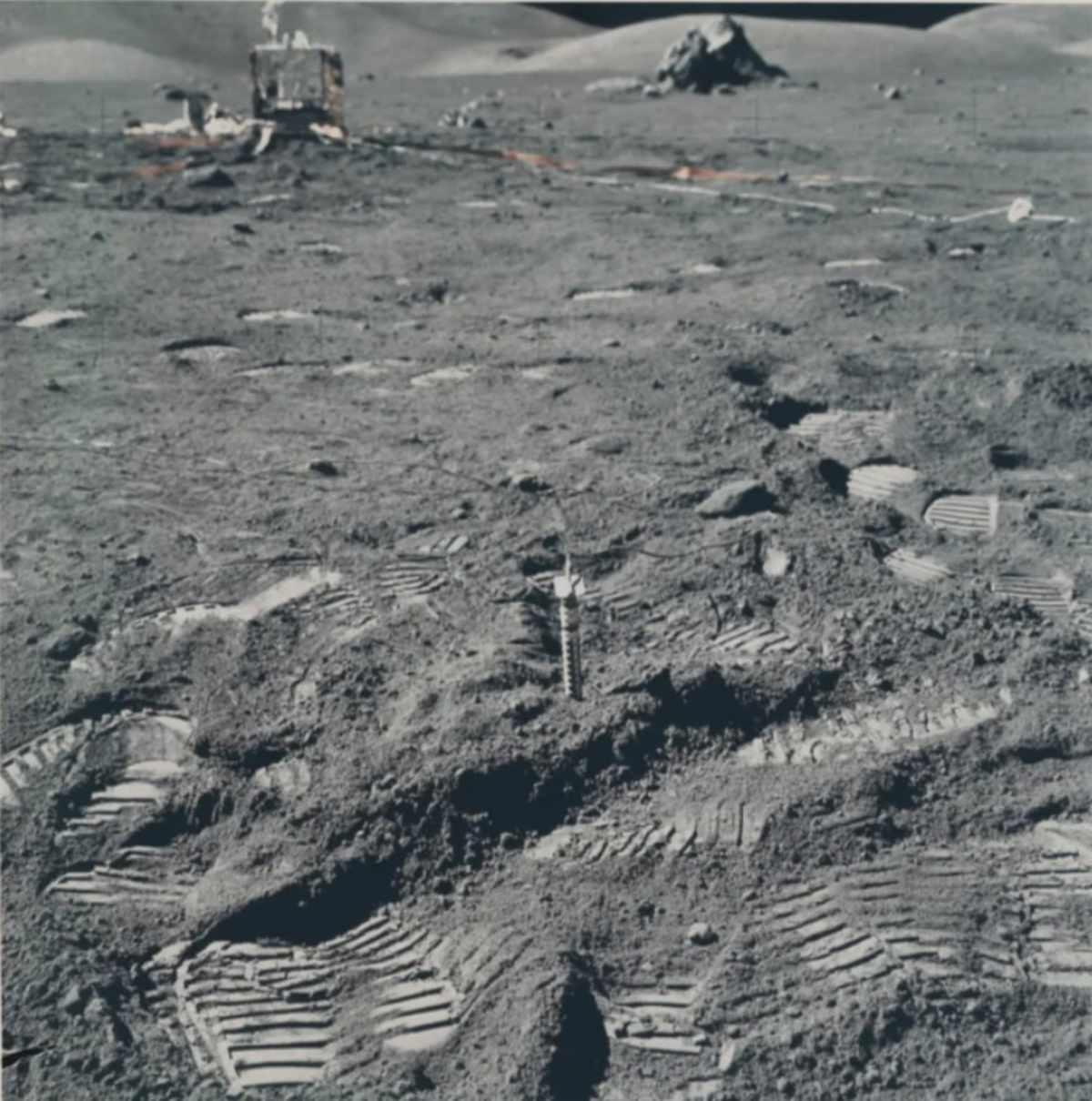
Apollo 17 remains an outstanding lunar mission: the longest stay on the Moon, the most samples collected, the best footage, and the only time a professional scientist walked on another world. But it also carries a bittersweet note. The footprints Cernan and Schmitt left in the Taurus–Littrow Valley are still there, untouched, waiting for someone to return.
And this is where the Artemis program comes in. Artemis II is, effectively, a test flight. In terms of crew it goes beyond the Apollo program. A woman is flying, a person of colour, a non-US citizen. Artemis is a dichotomy. It shows how far we've come as a society and, technically, how much ground we need to make up. With Artemis III, the plan is to return to the moon, and for an extended duration. But NASA has yet to receive a lunar lander capable of the job, so the date of this mission is both slipping and uncertain. The Chinese are aiming to send manned missions to the moon in 2030 - perhaps they will get there first.
But until someone returns, the last words spoken on the lunar surface belong to Gene Cernan, and the last footprints belong to a pair of explorers who made the Moon feel closer to us than ever before.